Phil Dodd

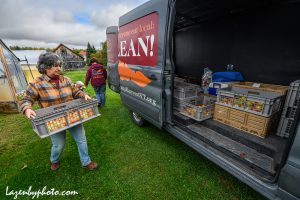
With the arrival of spring and the planting season, local organic farmers are busy at work even as they face challenges such as higher fuel and seed costs. Farmstands and farmers markets provide opportunities for selling their produce, but many farmers also sell to the Hunger Mountain Co-op in Montpelier.
In the fiscal year that ended June 30, 2025, the co-op sold $10.4 million in local products, or 34.6% of total sales, from 429 local vendors. In addition to produce, it sells basic local products such as eggs, cheese, milk, and bread, as well as value-added products such as locally made pasta and tempeh.
In the fiscal year that ended June 30, 2025, the co-op purchased $10.4 million in local products, or 34.6% of total sales, from 429 local vendors. In addition to produce, it sells basic local products such as eggs, cheese, milk, and bread, as well as value-added products such as locally made pasta and tempeh. The total number of local vendors selling at the co-op is 429.
Of those, 41 are farmers, and 96% of their produce is organic. Keeping that connection to local organic farmers requires some work because of the challenges facing farmers, according to Rowan Sherwood, the co-op’s community relations and marketing manager.
“It’s fairly fluid because some things are out of our control,” Sherwood said. “We’ve had some farmers that have just stopped farming for various reasons, environmental reasons, flooding and things like that. Our produce managers and buyers are always looking for new local options and really try to work with vendors, with farmers, especially.”
“Sometimes, a struggle with smaller farmers is that they might not be able to keep up with the volume,” she said. “But we really work with them. Maybe instead of doing a bunch of crops, we focus on a couple of crops that they can ramp up to meet the volume demands that we need. So the managers and buyers really work with people to get them in here if they want to be.”
Sherwood said the co-op is “bracing as everyone else is for the impacts of the global situation, but I think the fact that we do have so many local products is maybe a little bit of a buffer to some of that.”
Rising fuel costs and other challenges are making it a tough time to be a small local farmer. Government policy and industry trends have favored large farms for decades, Sherwood said.
Even large farms in the Midwest are under pressure this year, according to an April 30 article in the Wall Street Journal. “Fighting in the Middle East has sent fertilizer prices soaring,” the Journal reported. “The cost of diesel fuel for tractors and other farm machinery is also rising, leading farmers to cut whatever costs they can from their budgets.”
Closer to home, organic farmers — who do not rely on petrochemical fertilizers — have been organizing through programs such as the Northeast Organic Farming Association and meeting with local politicians to address the issues.
“They need all the help they can get,” according to a co-op produce manager who asked not to be named. “Grant money is drying up, and the cost of operating a farm is rising. Buy small, buy local. Farmers are the backbone of Vermont, and they need our support now more than ever.”
“Local farming also faces a generational problem,” he said. “It’s tough to find a kid who wants to take over their family farm. Often, the next generation of family farmers is off to university or moving to the city for more job opportunities. However, at least in our small corner of the world in Vermont, I do see a new generation of younger farmers stepping up: Blackbird Organics, Clearfield Farm, Cate Farm, Flywheel Farm, and Khelcom Farm, just to name a few.”
In central Vermont, Tony Lehouiller at Foote Brooke Farm is the largest produce supplier to the co-op. “It’s hard to imagine what the local farming community would look like without Tony,” the produce manager said. “He has been a mentor, teaching many of our younger farmers how to grow produce and operate their farms.”
While some local produce is grown in greenhouses, the busiest produce season is just now kicking in.
“Cate Farm starter plants are here,” he reported. “It’s a great time to get your home garden starters. All of the fresh local greens and spinach are coming in the door from Small Axe Farm, Blackbird Organics, and Pete’s Greens. But every week, new stuff is coming in. You name it, and we try to have it, if you can grow it in Vermont.”

A History of Local Focus
From its formative years in the early 1970’s, the co-op has encouraged local food producers, although the meaning of the word “local” has changed over the years. The co-op used to refer to products produced within 100 miles as local, according to Sherwood.
Then the state came down with some very specific requirements for calling something local, she said. “In my opinion, it is a little counterintuitive,” she said. “If it comes from southern Vermont, we can call it local, but if it comes from across the lake in New York, which might be physically closer, we couldn’t call that local.” She said the co-op is moving toward calling some products “regional.”
Deborah and Bob Messing of Montpelier were both long-time employees of the co-op, retiring in 2011 and 2012, respectively. They recall the co-op’s early efforts to support and encourage local food producers.
“Basically, the co-op has been a kind of incubator for local farmers and food producers, many of whom have gone on to expand their businesses and contribute to the economy and health food options for our community,” Deborah Messing said.
Messing was a member of the co-op dating back to the 1970s, although says she was not closely involved then because “we were living in the woods without a phone.” She went to work for the co-op in 1989 as a cashier and soon was managing the cheese department.
“I was fortunate enough to come on board just as interest in all these artisanal cheeses was gaining traction, partly from people having traveled to other countries and being introduced to their local cheeses, realizing there was a world beyond factory-made cheeses that were mostly designed to have a long shelf life,” she said. Eventually, the department she managed carried 250 varieties of cheese, many of them from local farms.
Messing recalls working with several cheese producers as they were starting out, companies such as Vermont Butter and Cheese (now Vermont Creamery), Lazy Lady, and Vermont Shepherd. Jasper Hill was another one.
“Jasper Hill came to me first at the old store, very bashfully, wondering if I would at all be interested in their cheese,” she said. “Now they’re internationally known, winning great prizes, and they have a very strong commitment to high standards and supporting local dairy farmers, and they make terrific cheeses.”
Similarly, Bob Messing, the former perishables buyer at the co-op, remembers his early contacts with new bread bakers, following in the footsteps of Upland Bakers. He mentioned names such as Elmore Mountain, Patchwork, and Bohemian.
“Local, small-time producers of all types would throw ideas to me, which I would throw to people who were interested in getting involved. I would also help them with their labeling, because there are legal requirements for their labeling, and they had to get their kitchen certified. I got a lot of people going.”

Red Hen Baking, founded in 1999, is another bakery that sold at the co-op from its earliest days. “They built a large following at the co-op and, in turn, Red Hen has supported more local agriculture by using locally sourced ingredients, wheat in particular,” Deborah Messing said, noting that Red Hen grinds 1,000 pounds of rye and wheat every week from local farmers.
“They also support local food banks by donating bread to Community Harvest.”
She reported a poignant moment when she and Bob joined the long line at the opening of Red Hen’s Montpelier café on May 1. “There was Randy [George, who owns Red Hen with his wife Eliza Cain] at the door, and he said something to Bob to the effect of, ‘Well, thanks to you, this is happening.’ It was very sweet.”