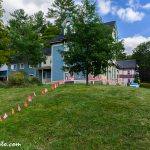
MONTPELIER — Sixteen kids have gathered in a circle under the trees at Sabin’s Pasture in Montpelier. The only sound is the wind moving the leaves above the group.
Then the teacher, Ryan Johns, begins speaking, and the kids turn towards him. Johns talks about the changing of the seasons and his tendency to resist that change. He ends with a quote from Albert Camus, “In the midst of winter, I found there was within me an invincible summer.”
He says good morning to the student next to him and the greeting travels around the circle. Individual kids then begin sharing what they’ve been reflecting upon during the six minutes of silence. Many mention noticing the sound of the wind moving the leaves.
Announcements follow, including a notice about a gender and sexuality meeting and a reminder that they’ll be voting for a student representative to the Pacem Board. One student asks, “Is there opportunity to see and hear the candidates before voting?” And 15-year-old, Ben Zandstra, one of those candidates, confirms this is important. There’s also mention of a Dungeons and Dragons club meeting, which gets an enthusiastic response, and talk about plans for running and biking events.
This is morning meeting at the Pacem School in Montpelier.
Located on the campus of the former Vermont College of Fine Arts, Pacem began 20 years ago with a group of homeschooling parents who wanted a means of supplementing their home-based instruction. They were also seeking more social experiences for their kids.
The school was originally part-time, but both full- and part-time options are now available to middle and high school students from sixth grade and older. Students come from Montpelier and surrounding areas, one traveling 50 miles to get to the school. Total enrollment is 20 students.
Pacem is ungraded and teachers use a combination of traditional and alternative assessment techniques. All students must complete a capstone project.
In the beginning the teachers were parents of the kids enrolled, but now there is a dedicated faculty, including Johns, and also the new director, Rebecca Yahm, who teaches history.
When asked about her approach, Yahm says, “I’m always looking at how I can encourage critical thinking.” She notes that she wants her students to avoid “the danger of a single story,” but instead to consider different perspectives.
Jenni Belotserkovsky teaches literature and language arts (and is also a cartoonist and reporter for The Bridge). On this Monday morning, her focus is journalism. She reminds her class that a journalist will be visiting that week and they should be thinking about the questions they would want to ask a journalist.
She asks them all to consider an article about their own lives. “What would be the headline? You can make it funny if you like.”
According to Johns, Pacem is not based on a specific pedagogy but does support the belief that “students are the architects of their own learning.”
Monday and Wednesday are for math, science, and language arts. Tuesday and Friday are dedicated to Spanish and studying skills. The students devote Thursdays to independent projects. Johns says the students “may explore anything from film and film production to veterinary studies.”
This morning the school day began with tutorials and a course entitled Read World Math and Beyond. Eight middle-school-age students are at the table. Johns has explained that the assignment is to “design your ideal school” and the dimensions must be to scale.
One student is designing a pottery school. Another is thinking about adding a McDonald’s Playhouse to her campus. Max Storellicastro is planning a University of Prehistoric Life. “I have an interest in extinct animals,” he says.
Asked if it’s challenging to teach a multi-age group of students each working at their own level on a single topic, Johns says, “It usually works out,” but notes that it’s trickier when there’s only one older or only one younger.
Zandstra values the multi-age approach.
“I really like it here,” he says. “You can’t have big fights. With such a close-knit community, everyone figures it out eventually.” He remembers arriving as a seventh grader. “The older kids were really important to me. They shaped my idea of Pacem, of how I see the world, always checking in on me. It was so important to me that I think I’ve gotten to be that kind of person.”
Before heading outside, all the kids circle around Johns as they vote on today’s outside game. They settle on Everybody’s It and troop through the front door. One of the younger students stops to examine a pale white butterfly on the glass. He lifts it off tenderly and says, “Beautiful,” then lets it go.