J. Gregory Gerdel
MONTPELIER — The Kellogg-Hubbard Library was the scene on June 29 for the launch of the Foundation for a Resilient Montpelier’s action-focused response to concerns about the reliability and inclusion of more locally produced foods in the current food system.
At the opening of the meeting the foundation’s executive director, Jon Copans, said to “support the local food system, we need not only to identify specific actions and opportunities, but to find the passion to do it.”
The area’s food supply, which depends on a combination of locally produced goods as well as global distribution systems, was one of the top four concerns that emerged from a separate meeting the foundation held in early June to identify community concerns. During that earlier meeting, Montpelier resident Dan Jones cautioned:
“We aren’t thinking about the possibility that the food supply system could collapse abruptly and sooner than anyone expects.”
To involve organizations currently managing food distribution systems in Vermont, Copans invited representatives to speak at the June 29 meeting. Recurring themes included: demand for affordable food is high; the perception that locally grown food is more expensive needs rethinking; and an enormous amount of surplus food is often wasted despite efforts to glean crops to distribute where they are needed.
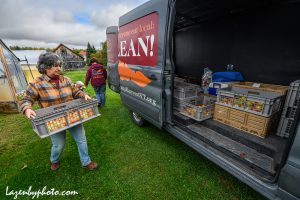
Rick DeAngelis, executive director of Just Basics, home of the Montpelier food pantry, said the organization distributes 400,000 pounds of food annually, much of it grown locally, to 400 to 500 households.
“These are people who need food,” he said.
DeAngelis said Just Basics has been encouraging a change in perspective about its services from ‘charity’ to ‘neighbors supporting neighbors,’ reflecting a commitment to mutual support.
Hunger Mountain Co-op sold more $10 million in local products from 429 local vendors, accounting for 34.6% of total sales in its most recent annual report, said Rowan Sherwood, community relations and marketing manager for the co-op.
Noting that the co-op has long identified food products as “local,” Becca Jordan, who works for the Center for an Agricultural Economy in Hardwick, suggested that the city begin evaluating food costs by including “food miles” in the calculation.
Meeting facilitator Sarah Waring, the executive director of the Northern Borders Regional Commission, compiled a list of future actions and existing programs that contribute to “localizing our food system.” Among the suggestions were:
- An inventory of farms and supportive infrastructure: the University of Vermont is seeking a grant to update the original study from 2016.
- Engage and educate more young people, as has been done with the food garden at Montpelier High School by Tom Sabo.
- Convene Vermont food producers to better understand their goals and priorities. “What do they want to do?” asked state Rep. Ela Chapin (D, Washington-5), who is also the director of the Vermont Farm and Forest Viability Program.
- Understand the different programs, food production, and needs of the five regional food hubs in Vermont.
- Improve harvest efficiency. Vermont has 16 million pounds of surplus food that is not used, noted Jeannie Bartlett, who manages the Feast Farm for the Montpelier Parks and Trees Department.
- Educate Vermonters about eating more seasonally.
- Map available private and public lands suitable for agriculture.
- Work with the Northeast Organic Farming Association (NOFA) and Vermont Farm to Plate, an organization supported by the Vermont Job Security Fund.