Carl Etnier

BARRE — “What’s the first thing we do tomorrow morning to combat what we face as a country?” It was the first audience question to the speaker at the Socialist Labor Party Hall in Barre at the Barre Historical Society’s Primo Maggio commemoration on May 1. The speaker misheard the question, however, and his answer revealed a lot about the huge amount of work he believes is necessary to stave off “a fascist America.” Still, the answer boiled down to: start locally.
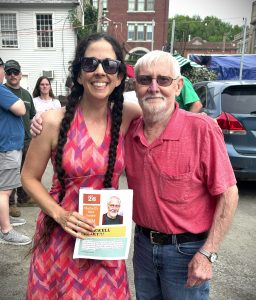
Erik Loomis, a labor history professor at the University of Rhode Island, was invited by the Barre Historical Society after organizer Karen Lane heard him on Democracy Now! on WGDR.
“He spoke about his book ‘A History of America in Ten Strikes,’” Lane said, “and we’re still very proud of the 35 children from Lawrence, Massachusetts, who came here during the 1912 Bread and Roses strike.”
Primo Maggio is Italian for May 1, and the event commemorates International Workers’ Day. Around 100 people turned out to hear the historian speak on “When Strikes Work.”
Loomis joked after the event, “I doubt anyone was expecting in-depth discussion of Colorado gold miner strikes in the 1890s and the Philadelphia transit strike of 1910.” Nevertheless, it was the detail of those and other stories that illustrated some of his main points: organized labor needs political power to protect worker rights, and workers today have few rights and little power.
Loomis called our times a new “Gilded Age,” referring to the era from the 1870s to the 1930s when, he said, “workers had no rights; the state actively worked with corporate America to crush worker movements; and the Supreme Court routinely ruled anything workers do that works is unconstitutional. When it felt like there wasn’t much hope.”
For Loomis, a historical turning point at the end of the Gilded Age was the 1935 National Labor Relations Act (NLRA), with its protections of organizing rights for workers. Yet those protections have been and are being dismantled.
“Only six percent of private sector workers are in unions,” Loomis said, “and that number is very likely to go down because Donald Trump is the greatest union buster in American history. He makes Ronald Reagan look like [International Workers of the World founder] Eugene Debs, because he has stripped collective bargaining rights from hundreds of thousands of federal workers.” For many in the labor movement, Reagan’s 1981 firing of striking air traffic controllers marked the turning point that led to steep declines in worker power.
Political power saved workers’ lives in the 1894 Western Federation of Miners strike in Colorado, which began after owners extended the workday to 10 hours without raising pay.
“The companies just assumed,” Loomis said, “that the states exist to serve as their private police forces.” But the miners had elected a populist governor who told them, “I’m not gonna do anything against the workers.”
When the strike began, mine owners threatened violence. The governor sent in the National Guard to stop the companies’ private strike-breaking forces. “He’s not really on the side of the workers; he just wants it neutral. And the workers win. They remain in power for a decade until a new governor comes and crushes them.”
Loomis highlighted other stories of decades-long organizing that built worker power, much of it predating legal protections like the NLRA and the Voting Rights Act. His book, “Organizing America,” chronicles key U.S. organizers.
It was against that backdrop that Loomis reacted strongly, both at the event and in a blog post the next day, when he misheard that audience member’s question as, “What is the one thing we can do tomorrow to stop Trump?” He commented afterwards, “There is no answer to that question…
“This is a very sick nation, and you have to treat the root causes… We have to fight Trumpism by reshaping our entire nation on different values. We have to rebuild real community, educate, mobilize, and figure out how to reach the mean average voter… There’s no one weird trick to win this… And if it starts anywhere, it starts in your own communities.”
He held up a role model who serves well as an answer to the question of what to do tomorrow, the “far too forgotten” civil rights organizer Ella Baker. Baker, he said, “built networks over decades in small southern towns, ignored by the NAACP, seen as irrelevant by most of the national civil rights organizations, but when the movement actually begins to move into these little communities, in the early 1960s, there’s one person in America who knows who to talk to in every single community, and it’s Ella Baker, because she had done the work. I think that that’s the work that has to be done.”
Organizing continues in Barre. Historical Society president Jake Hemmerick detailed efforts to restore the building after the 2023 flood, launch school programs on child labor, and host events like the Queer Craft Fair. The event underscored how local action remains vital.
For Primo Maggio attendees, Loomis’s historical lens on justice and rights offered a framework for understanding the present.