Phil Dodd

The long-awaited reconstruction of Montpelier’s East State Street is at risk of being delayed again — almost four years after voters approved a $7.2 million bond for the project that had seen several previous delays.
Whether the two-year project to replace water and sewer pipes and repave the deteriorating road kicks off this summer depends on two things: the final design chosen by city councilors at a special meeting on Wednesday, Feb. 4 at 6:30 p.m., and the status of a brewing right-of-way dispute.
The city council is expected to review two designs. One will be a modified version of a proposal by the city’s Complete Streets Committee, which wants to add a bike lane and continuous sidewalks on both sides of East State Street. On-street parking would be eliminated on much of the road.
Kurt Motyka, director of the Department of Public Works, told The Bridge he calculated that plan would require eliminating about 60 parking spaces stretching from the temporary post office at the lower end of the street all the way uphill to College Street. It may also involve new design work that would postpone the project, again.
The other design in play would rebuild the road and sidewalks as they are now and leave on-street parking as is. This design is a variation of one approved by councilors in May 2025, minus a retaining wall and new stretch of sidewalk that the Department of Public Works now says the city cannot afford.
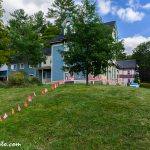
Meanwhile, the city faces pushback from some East State Street property owners upset about a recent right-of-way survey they believe infringes on their properties. The survey concluded the right-of-way was 66-feet wide, much wider than the typical 49.5-foot right of way on most Montpelier roads.
The dispute might end up in court, which could potentially delay the project another couple of years, although Motyka thinks construction could go forward within a 49.5-foot width even if the issue of a wider right-of-way is being litigated.
Extended Sidewalk and Retaining Wall
Last spring, the city council rejected the idea of adding a bike path to the project and, at its May 28 meeting, voted 5–1 to approve a design that involved adding a continuous sidewalk on the south side of the street. That would have required building a new retaining wall on a portion of the south side of the street.
On Aug. 13, the council voted to authorize funds to advance the design of a project with the retaining wall and new sidewalk section to the point where the design is 60% completed. Motyka told the council that the 60% design would provide updated costs and that the council could at that point vote to remove aspects of the project that were too expensive.
The 60% design level has been reached, and at its Jan. 21 meeting, the city council heard an update from Motyka on the design work and its costs. In a memo attached to the agenda, DPW wrote that the “staff has determined that the total project cost with the inclusion of the new sidewalk and retaining wall is too close to the total available funding to include in the project scope.”
“Given the limited remaining contingency and overall funding constraints, staff recommends removing the proposed sidewalk extension and retaining wall from the project scope,” the memo stated. “Eliminating these elements is expected to reduce the overall construction cost by approximately $500,000.”

Costs Have Risen
The bond approved in March 2022 to rebuild the road was for $7.2 million, but costs have risen. “Right now, without the wall, we are at $7.9 million, or about $700,000 over what we had hoped,” Motyka said. Further delays could push the total higher.
To make up the shortfall, Motyka said the city could tap a $3.5 million USDA grant that was intended to be split between an upgrade to the wastewater plant — which has not happened yet — and the East State Street project.
The city’s eight-member Complete Streets Committee has long advocated including a bike lane in the reconstruction plan, although without success to this point. Because the subject was back on the city council agenda, the committee sent a Jan. 19 letter to the council reiterating its position.
Is it Illegal Not to Add a Sidewalk?
The letter argued that the East State Street design should be changed to “1. Remove on-street parking from Cedar Street (where the parking meters end) to West Street. 2. Complete the sidewalks on both sides of the street between Hubbard Street and West Street, such that the sidewalks are continuous on both sides of East State. 3. Add an uphill bicycle lane between Cedar Street and West Street.”
The letter said that state statutes require the city to consider “complete streets” principles that accommodate all types of transportation, including bikes. “It therefore appears to us that pursuing Staff’s recommendation would be a violation of State law,” the letter states.
Motyka told The Bridge that preliminary work by the Department of Public Works suggests that to include two sidewalks and a bike lane, on-street parking would have to be removed below Cedar Street, all the way down to the temporary post office. This would eliminate both parking spaces with meters and some free spaces.
The Complete Streets Committee’s letter said, “On-street parking is convenient, but not necessary,” noting that the properties on East State Street all have off-street parking. However, many of the spaces on the lower part of the street are also used by people visiting or working downtown.
The committee’s request to extend the sidewalk on the north side of the street all the way to West Street, near the Greenway Institute green, is not feasible, Motyka said. It would be expensive and “we would be cutting into people’s banks if we were to try to put both sidewalks in,” he said.
In fact, he said, to potentially add a bike lane and new sidewalk on the south side, the Department of Public Works will present a design removing the existing sidewalk on the north side from Hubbard Street up the road to the crosswalk.
Motyka said he was “really surprised the council offered to revisit the bike lane because last April when we discussed this it wasn’t on the table.” He said he hoped councilors would stick with their earlier decision, minus the retaining wall and a stretch of new sidewalk. With that approach, “there is a 90% chance we’ll be building this summer,” he said.
The Department of Public Works is short-staffed, Motyka noted, and a chunk of his own time is now being taken up with flood-related FEMA work since the city’s finance director resigned.
Council Reconsiders Earlier Decision
If an extensive redesign is required, “it’s unlikely we will go to construction,” he said. That result might be unpopular with drivers negotiating the many bumps and potholes on the road that seems to get worse every year.
At its Jan. 21 meeting, the council chose to reconsider its bike lane decision and asked Motyka to prepare a competing design partly based on the Complete Streets proposal.
He said he needs a decision soon if anything is to happen this summer, which prompted him to ask if a special council meeting could be held before the next regularly scheduled meeting Feb. 11. At press time, the council had not yet found a time when all members could attend a special meeting.
One of the concerns expressed by the committee is that the existing crosswalk halfway between Hubbard and West streets is dangerous for pedestrians, especially children. Continuous sidewalks on both sides would eliminate the need for that crosswalk, they argue. The committee’s full proposal would require a new crosswalk from West Street to the north side of East State.
David Ory, a member of the committee and a resident of East State Street, told the council Jan. 21 that he lives near the crosswalk and sees kids crossing it. It is “literally terrifying to watch kids cross the street in order to make their way up to the college,” he said.
Motyka said if the crosswalk is retained, the design could include bump-outs and flashing lights at the crosswalk to make it safer for pedestrians to cross.
Right-of Way Dispute
A 2025 city survey of East State Street concluded it has a wider than normal 66-foot right-of-way. The survey was filed in the land records, but as Motyka explained to the city council, the city failed to follow the proper legal process, which requires that certified letters be sent to property owners when a survey is performed.
The city will soon be sending those certified letters, offering property owners a chance to provide comments or other feedback on the survey.
Jon Anderson, an attorney who owns four properties on East Street and used to live with his wife Betsy in the former Betsy’s B&B house on that street, objects to the surveyor’s conclusion about the width of the right-of-way. He said a right-of-way that wide would extend well into the front yard and even into the interior of some houses on East State Street.
“I am especially concerned that the mere existence of the so-called survey seriously affects the market value of the affected properties as any would-be buyer will factor such claims by the city,” Anderson told The Bridge.
Other property owners have also expressed concerns. David Ory of the Complete Streets Committee and an East State Street property owner told the council Jan. 21 that he supported Anderson’s objections, noting that the project does not need a right of way that wide and that houses located in the supposed right of way were built over 100 years ago.
Anderson believes that the city’s survey is not accurate. “In particular the survey is inconsistent with the presence of survey pins marking the boundary of the East State Street ROW,” he said. “These pins were in the ground when I bought my property at 76 East State Street more than forty years ago,” he said.
“Betsy and I want construction to proceed as soon as possible,” Anderson said. But if “the city chooses to file a new survey claiming permanent ownership of a wider ROW, we have no choice but to respond with court action, which is both expensive and may delay the project for many years.”
Motyka said he thinks the project can be built within the boundaries of a 49.5-foot right-of-way, and could proceed even if the issue has not been settled. He said the city may have some infrastructure outside a 49.5-foot right-of-way, and therefore he is reluctant to relinquish city rights beyond that amount without more research.
“The decision of whether or not to relinquish the public right-of-way will be for the city council to make,” Motyka said. “This will require public meetings and … require staff input and will likely be time consuming. The Department of Public Works is proposing this process be undertaken separately from the advancement of the project.”