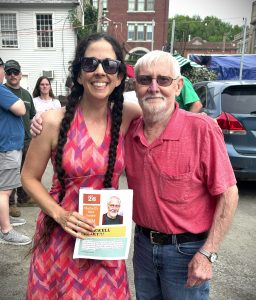
Kay Walsen and her partner, Jonathan Tollefson, are building a “luxury” tiny house. The building is 425 feet square (on the larger side for a tiny house) and has a cathedral ceiling.
Why a tiny house? Walsen is quick to respond, “We didn’t have the money to waste on using up the world’s resources.”
Their new home is being constructed in the village of Plainfield and is now almost complete, but getting this far has been a long journey.
“Before you begin, you have to think carefully about how you’re going to use the space,” says Walsen.
On Sept. 6, Plainfield held a home fair at the Town Hall Opera House. Thirty exhibitors shared information about buying, building, or mortgaging a new home. Many of them offered information about a variety of prebuilt smaller homes and tiny homes. After the fair, Walsen and Tollefson opened their (almost finished) home for a tour. About a dozen interested individuals of all ages arrived to peer into the corners and consider the plusses and minuses of living in their own small space.
The couple opted to act as their own contractor, and Walsen acknowledges that her own construction skills were pretty nonexistent.
“I don’t think I ever hit a nail on the head with a hammer before I started this project,” she says. Before even picking up that hammer, they obtained plans from the Pacific Northwestern architectural firm founded by Ross Chapin, whose company promotes the building of small and cottage-size houses.
They thought about ways in which to maximize their space with built-in furniture such as bookcases and a dining nook. All of the plumbing is compactly situated in the same area.
When asked about the challenges of having friends over in a tight space, Walsen says “It will be cozy,” but not much different from the small apartment they live in now. She adds that they’ll be using HEPA filters to protect air quality.
The affordability of a tiny house in both cost and energy savings is attractive, but there are other options for low-cost home ownership. Condominiums, for example, can be less expensive than a full-size house, but that choice involves belonging to a homeowners association with monthly fees, lack of control over one’s property, and the occasional assessment for maintenance projects.
Among the other small-home options, living in a yurt can bring you back to the basics as you carry water (no indoor plumbing) and haul firewood. Also, some yurts have no electricity. A central Vermont family may also apply to Downstreet Housing and Community Development’s Shared Equity Program. The nonprofit organization offers down-payment-assistance grants, up to 20% of the market price to income-eligible buyers. According to Downstreet’s website, “The grant remains with the house benefitting future eligible buyers when the house is sold. In return, the original buyers agree to limit the profit they make from the home’s appreciation.”
For some, however, a tiny house may offer the best chance to own a home.
When tiny houses first appeared on the scene, it could be difficult to find an insurer or a bank that would offer a mortgage. It’s now getting easier to find both. Local institutions that mortgage tiny houses include the EastRise and North Country credit unions and Union Bank.
It’s still true that tiny houses are described accurately as … tiny. Walsen notes that she and her partner formerly lived in a 200-square-foot cabin.
She notes that Tollefson spent time in urban Tokyo, a city where 95-square-foot micro apartments are not uncommon. Walsen herself has a fondness for small spaces.
“I would feel uneasy in a large house. I can’t imagine having a room I don’t go into every day,” she says.
A lot depends on what you’re used to, and owners may have the option of adding on to their tiny home in the future if local building and zoning codes allow.
Some may be attracted to a tiny house for reasons beyond affordability and protecting the environment.
Elizabeth Burke of Montpelier says she dreams of finding a piece of land in the woods for her own new home.
“You feel closer to nature in a tiny house. There are fewer barriers,” she says.
When asked what advice Walsen would give to those interested in tiny house life, she laughs, “Add a door. Sometimes you’ll just need to get away.”
For more information about the Downstreet Equity Program, go to downstreet.org